Banding vs. Pressure-Sensitive Labels: Which Offers Better Tamper-Evident Packaging?
Tamper evidence has become an important part of modern packaging. Retailers want confidence that products have not been opened before reaching the shelf. Customers want a clear visual sign that the product they are buying is secure. And producers need a solution that fits into their packaging process without adding unnecessary complexity.
For many products, tamper evidence is still created with a small label or sticker. It is placed over the opening point of a pack, container, or lid to show whether the product has been opened.
But is a small sticker always enough?
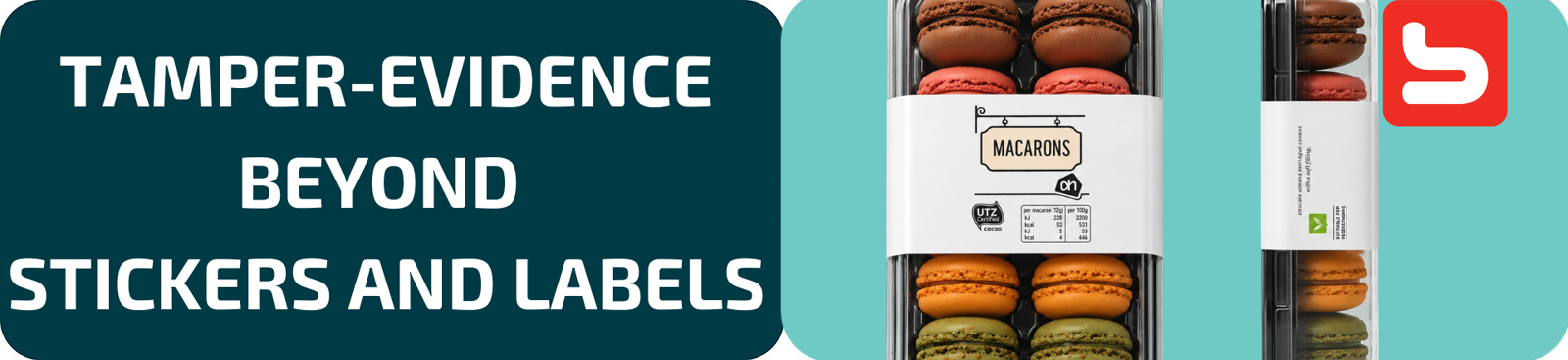
For packaging such as clamshells, trays, containers with lids, fresh food packs, confectionery packs, and retail products, banding offers a stronger and more functional alternative. Instead of sealing only one small point, banding material is wrapped around a section of the packaging. This creates a clear, visible, and strong seal around the pack.
So, when comparing banding vs labels or stickers, which solution offers better tamper evidence and more packaging functionality?
Labels and stickers: simple, but limited
Labels and stickers are often used because they are low-cost and easy to apply. A small sticker can be placed over the opening of a container, clamshell, box, or lid to show whether the pack has been opened.
For some applications, this may be enough. Especially when the product is low-risk, low-value, or does not require strong shelf presentation.
However, stickers also have clear limitations.
A sticker usually only secures one small area of the pack. This means the packaging may still be able to shift, open slightly, or be tampered with, depending on the packaging type and where the sticker is applied.
Stickers can also be less visible on the shelf. A small pre-printed or white label does not always stand out, and it often adds little to the overall presentation of the product.
Banding: tamper evidence around the pack
Banding creates tamper evidence in a different way.
Instead of placing a small sticker over one opening point, banding material is wrapped around a section of the packaging and sealed at the optimal tension. This creates a snug band around the pack.
For clamshell packaging or containers with lids, this means the pack cannot be opened without first breaking or removing the band. The band leaves no extra room for the lid or opening section to be lifted unnoticed.
As long as the band is intact, the packaging remains visibly closed.
This gives retailers and customers a clear signal: the pack has stayed sealed from production to shelf.

Functionality: where banding adds more value
Tamper evidence is only one part of the comparison. Packaging also needs to perform well in daily operations.
This is where banding offers additional functionality.
A band can help keep lids, clamshells, trays, and containers securely closed during handling, transport, and stocking. Because the material is applied at the right tension, it stays in place without needing adhesive on the pack itself.
This is especially useful for products that need a clean and secure presentation, such as fresh food, bakery products, confectionery, ready meals, personal care items, and retail packs.
Banding can also combine tamper evidence with other packaging functions. Depending on the application, the band can be used to carry product information, barcodes, variable data, ingredients, promotional messages, or visual design. This means one material can support multiple packaging needs.
A sticker usually does one job.
A band can do more.
Presentation: visible security on the shelf
Tamper-evident packaging should not only work technically. It should also make the customer feel confident.
A small sticker can sometimes look like an afterthought. It may interrupt the packaging design or be placed in a position that is not immediately visible.
Banding can create a cleaner and more premium appearance. The band becomes a visible part of the packaging and can be designed to match the product, brand, or shelf environment.
This matters because packaging is often judged in seconds. If the seal is easy to see, the product feels more secure. If the pack looks clean and intentional, it supports customer confidence.
For retail products, that combination is valuable: visible security and strong shelf presentation in one solution.
Sustainability and separation after use
Labels and stickers usually rely on adhesive. Depending on the material combination, this can complicate separation or recycling after use. Adhesive residue can remain on the packaging, and the label may not always be easy to remove cleanly.
Banding is applied without adhesive on the product packaging. The band can be removed from the pack after use, making material separation easier for the end user.
This can be especially relevant when the packaging and band are made from different materials. Instead of permanently attaching a sticker to the pack, the band can be separated more clearly.
For producers looking to reduce packaging complexity and support easier disposal, this is an important advantage.

Seal strength without adhesives
Tamper-evident labels and stickers rely on adhesive to stay in place. Over time, or in conditions with moisture and condensation, adhesive performance can weaken. This can reduce the reliability of the seal and make the packaging less secure during handling, transport, or shelf life.
Banding works differently. The banding material is sealed to itself using heat-sealing technology, not glued to the packaging. This creates a strong, stable seal around the pack without depending on adhesive strength.
Because the band is applied at the right tension and sealed securely, it stays in place around the packaging. Banding material can also withstand moisture and condensation without losing seal strength, making it a reliable solution for chilled, fresh, or humid environments.
Banding vs labels or stickers: the conclusion
Labels and stickers can provide a basic tamper-evident indication. They are simple, familiar, and easy to apply.
But their functionality is limited. They usually secure only one small point, can be less visible on the shelf, and often rely on adhesive.
Banding offers a more complete tamper-evident packaging solution.
By wrapping material around the packaging and sealing it at the optimal tension, banding helps keep the pack closed until the band is broken or removed. This makes the tamper-evident indication clear, visible, and easy to recognize.
At the same time, banding can add extra functionality. It can support product presentation, communication, labeling, and easier material separation after use.
For brands and producers looking for a clean, visible, and functional tamper-evident solution, banding offers more than a sticker.
Curious to learn more about banding?

Applications of banding

Benefits of banding

Banding vs. other solutions

10 Reasons to switch to banding

Zwartz - From shrink wrap to paper bands

Novatrade - Improved quality and efficiency

Packaging food products
