
How to reduce packaging waste in retail-ready packaging
Retail-ready packaging is built for speed. It helps products move efficiently from transport to shelf, keeping retail operations smooth and organized.
But there’s a downside.
Many retail-ready packaging formats still rely heavily on excess materials like shrink wrap, trays, sleeves, and outer cartons. These are often types of packaging that are removed and discarded almost as soon as products arrive in-store.
As retailers and manufacturers push for more sustainable operations, reducing packaging waste has become a growing priority. The challenge is finding smarter ways to cut material use without sacrificing product protection, transport stability, or shelf presentation.
Why retail-ready packaging creates so much waste
Retail-ready packaging has to perform across every stage of the supply chain:
- Transport
- Distribution
- Shelf replenishment
- In-store handling
To keep products secure throughout this process, many traditional packaging methods add multiple protective layers. The problem is that much of this material serves only a short-term purpose before ending up as waste.
This often results in:
- Large volumes of discarded packaging
- Higher material costs
- More labor is spent handling waste
- More complicated recycling streams
- Unnecessary packaging consumption
In many cases, products are simply overpackaged.
The problem with traditional retail packaging methods
Traditional retail-ready packaging often relies on materials, such as shrink wrap, display cartons, plastic overwrap, and additional outer packaging, to keep products secure during transport and handling. While these solutions can improve product stability, they also increase packaging waste and material consumption throughout the supply chain.
In many cases, they add unnecessary bulk, reduce product visibility on the shelf, increase transport weight, and slow down shelf replenishment in-store. As a result, retailers and manufacturers are left managing higher material costs, more packaging waste, and less efficient operations overall.
Simplifying packaging to reduce waste
One of the most effective ways to reduce retail packaging waste is to simplify how products are grouped and prepared for display.
Minimal packaging strategies focus on:
- Using less material
- Reducing unnecessary packaging layers
- Improving handling efficiency
- Simplifying waste collection and recycling
The result is a cleaner, more efficient packaging process with lower environmental impact and reduced operational costs.
How banding helps reduce retail packaging waste
Banding offers a smarter, more streamlined approach to retail-ready packaging.
Instead of fully enclosing products in shrink wrap or cartons, products are secured using a narrow paper or film band. This keeps them stable while reducing packaging material.
This helps businesses:
- Reduce packaging waste in stores
- Minimize packaging material usage
- Improve product visibility
- Simplify recycling and disposal
Products stay secure, retail-ready, and easy to handle without the excess packaging.
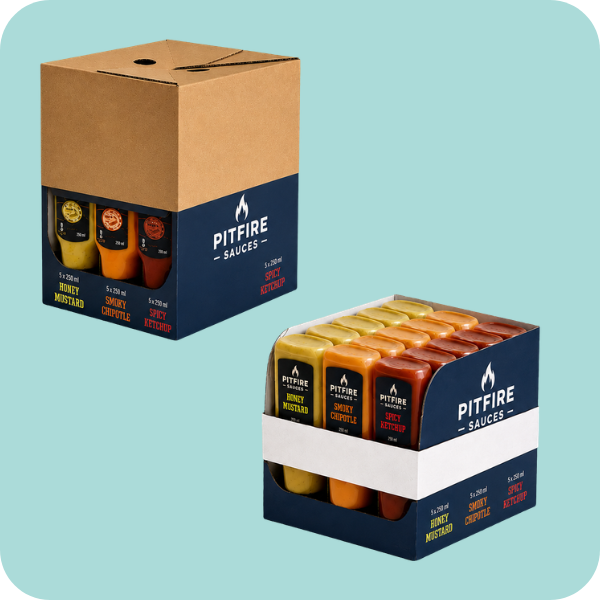
Easier waste handling in retail environments
Retail stores already manage large amounts of packaging waste every day, making waste handling an ongoing operational challenge. Reducing the amount of packaging material entering stores can help simplify back-of-store processes and improve overall efficiency.
Banding helps support this by reducing loose packaging materials, making packaging easier to separate and dispose of, and minimizing the overall volume of waste generated in retail environments. With less material entering the store, there is ultimately less waste to handle, remove, and manage.
Sustainable retail-ready packaging without sacrificing efficiency
Reducing packaging waste should never come at the expense of operational performance.
Banding helps maintain efficient retail-ready packaging by supporting:
- Shelf replenishment speed
- Handling efficiency
- Transport stability
- Retail presentation
It’s a more sustainable packaging solution that still delivers on speed, functionality, and retail performance.
Conclusion
Reducing packaging waste in retail-ready packaging is about more than sustainability alone. It’s also about improving efficiency, lowering costs, and simplifying operations across the supply chain.
By eliminating unnecessary packaging materials, businesses can create cleaner, more efficient retail processes while reducing waste at every stage.
Banding supports this shift by helping companies create retail-ready packaging solutions that use less material and become more efficient.
Curious to learn more about banding?

Applications of banding

Benefits of banding

Banding vs. other solutions

10 Reasons to switch to banding

Zwartz - From shrink wrap to paper bands

Novatrade - Improved quality and efficiency

Packaging food products
