
Laundry bundle identification with banding: From barcodes to variable data printing
In commercial laundry operations, accurate identification is critical. With thousands of items moving through sorting, washing, and delivery every day, strong laundry traceability depends on clear, reliable labeling.
But today, it’s not just about barcodes. Modern operations require flexible identification, ranging from customer names to order details and tracking data.
That’s where banding with variable data printing changes the game.
The problem with traditional laundry labeling
Many laundries still rely on plastic bags with inserts or loose tags for product identification. While common, these methods often fail under real conditions.
Labels can get lost, damaged, or separated from the bundle, breaking the connection between the product and its data. This disrupts the entire tracking system.
At the same time, plastic packaging adds extra material, handling steps, and costs, making operations less efficient and less sustainable.
Why identification and traceability matter
Without reliable identification, even efficient laundries face challenges.
Items become harder to track, manual checks increase, and sorting or delivery errors become more likely. This impacts both operational efficiency and customer satisfaction.
In high-volume environments, strong laundry bundle identification is essential to keep workflows running smoothly.
The shift to smart banding with variable data printing
Modern laundries are moving toward banding with integrated printing, combining bundling and identification into one step.
A paper or film band is applied around each bundle to keep items secure. At the same time, variable data can be printed directly onto the banding material.
This means each bundle can carry its own unique information, such as:
- Barcodes for scanning and tracking
- Customer names or locations
- Order numbers or batch details
- Product types or quantities
Because the data is printed directly on the band, it stays visible and attached throughout the entire process.
Even more importantly, the band replaces plastic bags or shrink wrap, simplifying the entire laundry packaging and labeling process.
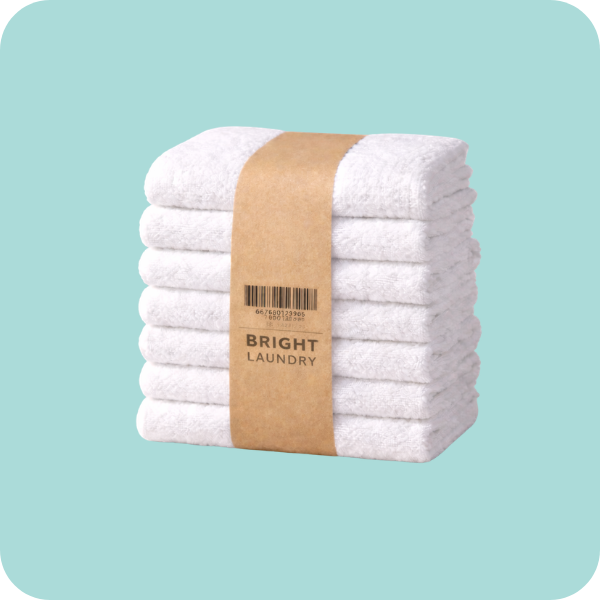
Smarter Identification with Printed Banding
Printing directly onto banding material transforms it into more than just a bundling tool; it becomes a flexible identification system.
With variable data printing during banding, laundries can adapt labeling to different customers, orders, or workflows without changing materials or processes.
Barcodes support automated scanning and integration with laundry tracking systems, while readable text helps staff quickly identify bundles without opening them.
Because labeling and bundling are combined, there’s no risk of lost tags or mismatched information.
Key benefits for commercial laundry operations
Using banding with variable data printing improves both efficiency and accuracy.
Bundles remain securely packed while carrying all necessary identification. Material use is reduced by eliminating plastic packaging, supporting more sustainable laundry operations.
At the same time, fewer handling steps and better readability lead to faster processing and fewer errors. The ability to print different data on each band also adds flexibility, allowing laundries to adapt to changing customer needs.
The result is a more streamlined and scalable workflow.
The bigger picture: One step, multiple functions
Banding brings together bundling, labeling, and identification into one solution.
Instead of managing separate labels, packaging materials, and processes, laundries can rely on a single system that secures and identifies every bundle.
With variable data printing, this system becomes even more powerful—supporting traceability, customization, and automation at the same time.

Applications of banding

Benefits of banding

Banding vs. other solutions

10 Reasons to switch to banding

Zwartz - From shrink wrap to paper bands

Novatrade - Improved quality and efficiency

Packaging food products
