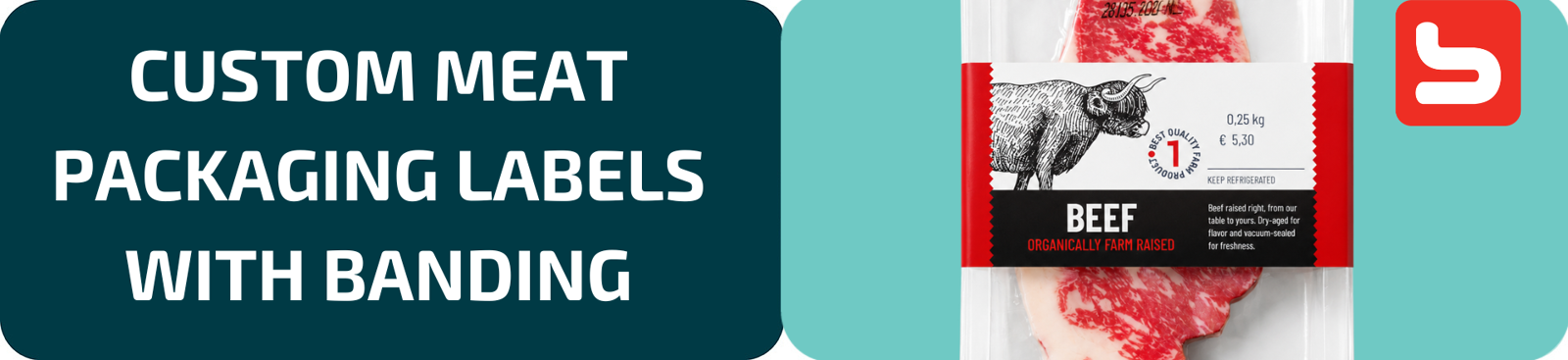
Label your meat packaging with a smarter solution
Meat packaging labels play an important role in product presentation and food information.
They help consumers understand what they are buying, provide essential product details, and ensure that information, such as weight, price, ingredients, and barcodes, is clearly displayed.
Traditionally, this information is added using adhesive labels, in-mould labels, or printed sleeves.
Banding offers an alternative approach.
By printing directly onto the banding material, the band itself can be used as the label for meat packaging. It can carry branding, fixed product information, and variable data while being applied around the pack.
This creates a flexible labeling solution for meat trays, skin packs, vacuum packs, and other packaging formats.
Two ways to label meat packaging with banding
Banding can be used as a labeling solution in two main ways.
The first way is with preprinted banding material. This is ideal for information that is known in advance and stays the same.
The second way is with variable data printing during application. This is ideal for information that changes per product, weight, or production run.
Together, these two options make banding a flexible alternative to traditional meat packaging labels.
Using preprinted banding material as a label
Preprinted banding material can include information that remains the same across a product range or production batch. This may include brand logos and colours, product names, and ingredients.
The printed band is applied around the meat packaging during the banding process. This allows the banding material to function as a custom meat packaging label without requiring a separate adhesive label or full cardboard sleeve.
For products where visibility is important, the band can provide a clear communication surface while leaving a large part of the packaging uncovered.
The result is a clean presentation that combines branding and product information in one material.

Variable data printing during application
Not all information on meat packaging is known in advance.
Weight, price, batch codes, use-by dates and barcodes can change from one pack to the next.
For this type of information, banding material can be printed during the packaging process.
An integrated printer adds the variable data directly onto the band shortly before it is applied. The banding machine can receive this information from connected systems, such as weighing equipment, ERP software or production databases.
This means each pack can receive the correct information at the right moment.
Variable data printed onto the band may include:
- Product weight
- Price
- Barcode
- Use-by date
- Product code
This turns banding into a real-time labeling solution.
Instead of weighing the product, printing a separate label and applying it in another step, the information can be printed directly onto the material used to band the pack.
Weigh, price and label with SmartBand™
Products sold by weight require particularly accurate labeling.
Each pack needs to display the correct weight and price, together with a barcode that matches the product data.
With an integrated weigh-price-print-band process, these steps can be combined.
The product is first weighed. The system calculates the correct price and generates the required data. This information is then printed directly onto the banding material before the band is applied around the pack.
The process can include:
- Weighing the product
- Generating the weight, price, and barcode
- Printing the data onto the band
- Applying the band around the meat packaging
This reduces the need for a separate label application stage and helps simplify the packaging line.
For meat producers handling multiple products, weights or batch sizes, this can provide a more flexible way to manage labeling.
Keeping the product visible
Product visibility is an important part of meat packaging.
Consumers often want to inspect the colour, cut and quality of the product before making a purchase. Large labels or full sleeves can limit this visibility.
Banding covers only part of the pack.
This creates space for branding and product information while keeping much of the meat visible through the packaging.
For trays, skin packs and vacuum packs, this can help maintain a transparent and attractive product presentation.
The band becomes a focused communication area rather than covering the full surface of the pack.
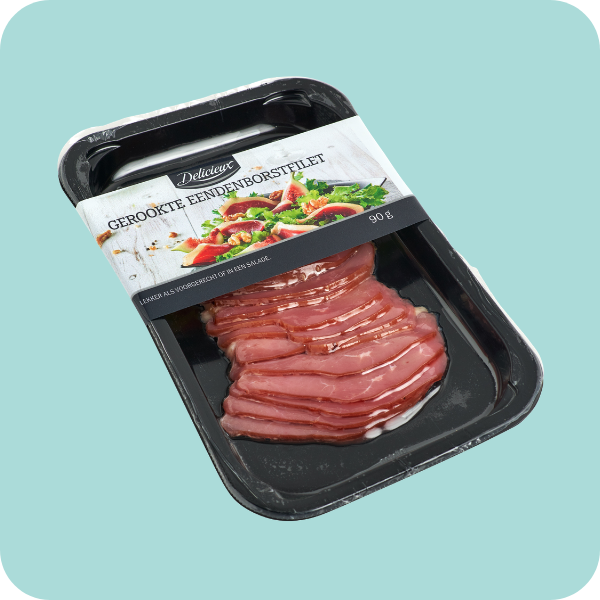
Labeling meat packaging without adhesives
Most traditional labels rely on adhesive to remain attached to the packaging.
Banding material is applied without glue.
This means the product information can be added without placing an adhesive label directly onto the tray, film or container.
After use, the band can be removed separately from the primary packaging. Depending on the materials used, this can support cleaner separation of packaging components.
It also avoids sticky residue and labels that can be difficult to remove.
For meat producers looking to simplify packaging structures, adhesive-free banding can offer a practical advantage.
A smarter way to create meat packaging labels
Using banding as a label gives meat producers more freedom in how they present products and manage information.
Fixed branding and product details can be preprinted, while changing data, such as weight, price, barcode and use-by date, can be added during application. This makes it possible to create a clear, flexible labeling solution without relying on multiple separate packaging components.
For suitable meat packaging applications, banding can help simplify the process, keep the product visible and create a cleaner presentation on the shelf.
One material. Fixed and variable information. A more efficient way to label meat packaging.
Curious to learn more about tamper-evident banding?

Weigh, price, band

Branding by banding

Banding vs. alternative solutions

10 Reasons to switch to banding

Packaging food products
