
5 Skin packaging challenges banding helps solve
Skin packaging is designed to put the product first. The transparent film follows the contours of the meat closely, creating a clean presentation that lets shoppers see its colour, freshness, and quality before they buy.
For premium cuts of meat or fish, that visibility is a major advantage. But it also creates specific packaging challenges.
Skin packaging does not provide ample surface area for branding and labeling, and products naturally vary in shape and size, making each final product unique.
This is where banding offers unique advantages compared to alternatives and easily solves the challenges presented by skin packaging. Here are five common challenges banding can help solve and elevate skin packaging.
1. Finding enough space for branding and labeling
A skin pack has a lot to communicate.
There is the brand and product name, but also ingredients, nutritional values, and other required product details. Finding room for all of that can quickly become difficult, particularly when you want to keep the front of the pack clean and uncluttered.
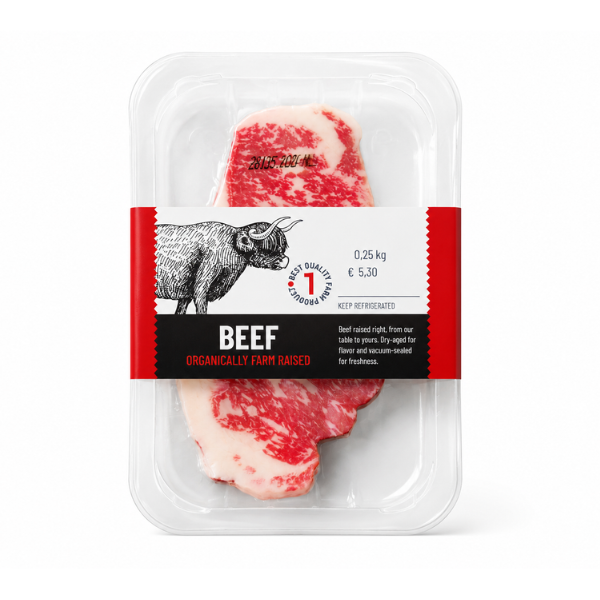
Banding gives you a 360° printable surface
Rather than limiting your communication to one label on top of the pack or on the back, banding material wraps around the entire packaging.
That creates a 360° surface that can be used for branding and labeling. Instead of squeezing everything into one small area, you have more freedom to give both the brand and the information the space they deserve.
2. Dealing with different product shapes and sizes
Meat is a natural product, so variation is unavoidable.
One steak may be thicker than the next. Different cuts create different contours, and even when the same tray is used, the finished skin pack can vary in height and shape because the film closely follows the meat inside.
That makes consistency an important consideration when choosing a branding and labeling solution.
Banding adapts to the finished pack
Banding does not rely on the product having the same shape every time.
The banding material is wrapped around the complete skin pack and sealed at controlled tension. This allows it to accommodate normal differences in pack height and product shape while still sitting neatly around the packaging.
So while the meat inside may naturally vary, the branding around it can maintain a consistent appearance.
3. Adding weight and price without compromising the design
Variation in meat does not stop at shape and size.
Individual products can also have different weights and, as a result, different prices. That means every pack needs an area where this changing information can be displayed clearly.
Traditionally, that can mean adding another label on top of an already branded pack.
Print weight and price directly onto the banding material
With SmartBand™ technology, variable information can be added directly to the banding material during production.
Weight and price information, together with the corresponding barcode and other variable data, can be printed for each product before the banding material is applied.
That means, with banding, the material can not only carry the branding and the fixed product information, but also the data that needs to be printed after weighing.
4. Keeping enough of the meat visible
Visibility is one of the many reasons skin packaging works so well for meat.
Shoppers want to see what they are buying. Colour, marbling, shape, and freshness all help them form an impression of quality before the pack ever reaches their basket.
The challenge is making the product stand out and draw attention without hiding that product behind packaging.
Banding keeps the communication area focused
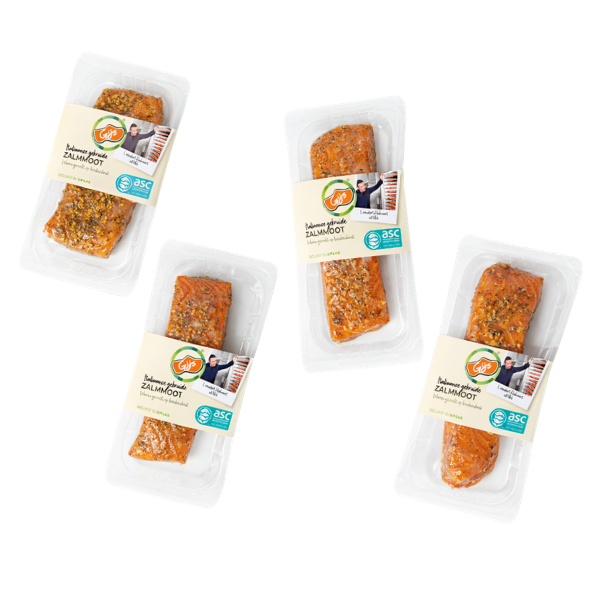
Banding adds the printable surface you need without covering a large portion of the skin pack.
Because banding material is available in different widths, the format can be matched to the amount of communication space required.
That keeps the product at the centre of the packaging while still giving the brand a clear presence on the shelf.
5. Reducing liner waste from the labeling process
Branding and labeling do not only affect what shoppers see on the shelf. They also create material flows behind the scenes.
Pressure-sensitive labels are typically supplied on a release liner. Once the label has been applied, that backing material has served its purpose and needs to be collected, handled, and disposed of.
Across larger production volumes, that can add up to a considerable amount of waste.
Banding works without adhesive or release liner
Banding takes a different approach.
By wrapping the material around the skin pack and sealing it to itself, there is no need for adhesive or a release liner.
For packagers, that means no liner waste is created during application, and less waste has to be disposed of.
The benefit continues after purchase. Consumers can easily remove the banding material and read the cooking instructions or nutritional information without having to struggle with the stickiness of adhesives.
Looking for the right branding and labeling solution for your skin packs?
Whether you already use skin packaging or are considering making the switch, branding and labeling are worth thinking about early in the process.
The right banding solution will depend on your tray dimensions, product variation, production speed, information requirements, and desired presentation.
Bandall can help you explore how banding could work with your skin packaging and find the right balance between branding, labeling, and product visibility.
Curious to learn more about banding?

Branding by banding

Bundling by banding

Banding vs. Adhesive Labels

10 Reasons to switch to banding
