
How printing companies can bundle printed materials more efficiently with banding
After all the work that goes into printing and finishing a product, the last thing you want is for the end result to have damaged corners, messy stacks, or unnecessary packaging around it.
Whether you are bundling brochures, labels, folding cartons, leaflets, envelopes, or other printed materials, the way products are prepared for handling and transport has a direct impact on both efficiency and presentation.
Banding offers printing companies a simple way to keep printed products securely together while using relatively little packaging material. And because the process can be adapted to different products, bundle sizes, and production environments, it can fit into anything from small post-press operations to highly automated production lines.
So, where can banding make a difference?
Secure bundles with the right tension
Printed products can be surprisingly sensitive.
A stack of brochures needs enough pressure to stay neatly together, but too much pressure can damage the edges. In-mold labels or thin labels may need even more careful handling and behave differently than brochures.
With banding, the tension can be adjusted to suit the product being bundled. This helps keep stacks aligned and secure without applying more pressure than necessary.
Reduce the amount of packaging around each bundle
In high-volume print production environments, small amounts of packaging quickly add up.
If you are processing thousands of bundles every day, using just a little less material per bundle can make a noticeable difference over time.
Banding uses a narrow strip of paper or film banding material around the product. Unlike shrink film, it does not need to cover the entire bundle. And for products that only need to be grouped rather than fully protected, it can also remove the need for additional packaging such as boxes.
This means less packaging material needs to be purchased, stored, handled, removed, and disposed of.
For printing companies looking to make their post-press process more efficient, banding offers a compelling solution.
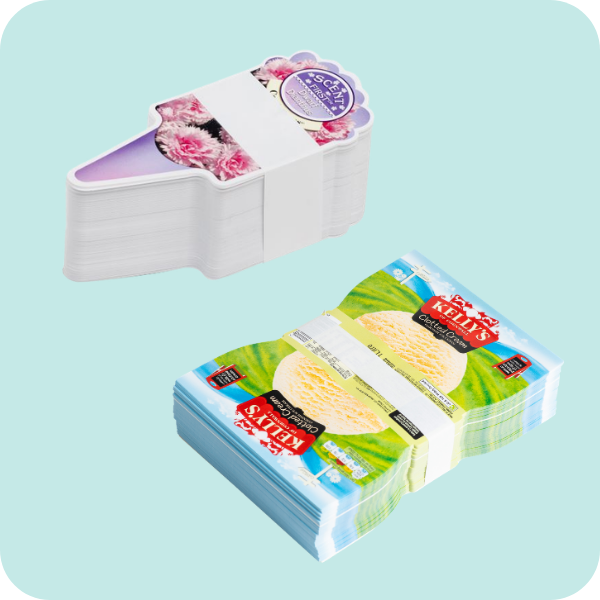
Use one or more bands for extra stability
Not every printed product needs to be bundled in the same way.
A small stack of leaflets may only require one band. A wider stack of cartons may require two bands to keep everything properly aligned.
With banding, the number and position of the bands can be adapted to the product and bundle size. That gives printing companies more flexibility when different jobs move through the same production environment.
Instead of using more packaging than necessary for every product, the bundling method can be matched to what the job actually requires.
An alternative to straps, shrink film, and boxes
Printing companies already have several ways to bundle finished products. The right option depends on what is being packed and what happens to it afterwards.
Plastic strapping offers a strong hold, but concentrated tension can sometimes damage corners or leave marks on sensitive products.
Shrink film keeps products together and provides full coverage, but it uses considerably more material and normally requires a heat tunnel as part of the packaging process.
Boxes provide more protection, but also introduce additional material, storage space, and handling.
For applications that mainly require products to stay grouped, aligned, and easy to handle, banding offers a much simpler and more efficient solution.
A smarter way to bundle printed materials
For printing companies, efficient bundling is ultimately about more than keeping a stack together.
The bundling method should protect the finished product, fit efficiently into production, use only the material that is necessary, and make handling easier afterwards.
Banding brings those requirements together in one process.
It can help keep printed products neatly aligned, reduce packaging material, protect sensitive edges, and automate one of the final steps in the post-press workflow.
So after investing time and attention in creating a high-quality printed product, you can make sure the way it is bundled matches that same standard.
Less packaging. Secure bundles. A more efficient finishing process.
Do you want to elevate your packaging?
Together we can find opportunities to optimize your packaging.

Applications of banding

Benefits of banding

Banding vs. other solutions

10 Reasons to switch to banding

Zwartz - From shrink wrap to paper bands

Novatrade - Improved quality and efficiency

Packaging food products
