
Choosing the right banding machine for your production process
Selecting the right banding machine is a strategic decision that directly affects your production efficiency, packaging costs, and product presentation. Whether you are bundling or branding products, the right machine ensures consistent performance and long-term reliability.
In this guide, we explain how to choose the right banding machine for your production process and which factors have the greatest impact on performance, scalability, and return on investment.
If you are still exploring available solutions, you can first review our banding machines to understand the different system types available.
Why choosing the right banding machine matters
A banding machine does more than apply banding material around a product. It influences:
- Production speed
- Labor efficiency
- Material usage
- Sustainability performance
- Overall packaging quality
Selecting the wrong machine can quickly create bottlenecks, limit growth, or result in unnecessary capital expenditure. The goal is to match the machine configuration precisely to your operational requirements.
1. Define your production volume and required speed
The first step in choosing the right banding machine is determining your required output. Production volume often determines whether automation is necessary.
Key questions to consider:
- How many products must be banded per hour
- Is production continuous or batch-based
- Do you expect seasonal peaks
- Is downtime extremely costly
For lower volumes or flexible work environments, a semi-automatic banding machine may provide sufficient capacity while keeping investment costs lower.
For high-volume production lines, a fully automatic banding machine offers higher cycle speeds, consistent band tension, and minimal operator involvement. These systems are ideal when banding must keep pace with fast packaging lines.
2. Determine the right level of automation
Automation influences labor dependency, efficiency, and scalability.
Semi-automatic banding machines
Suitable when:
- Production volumes are moderate
- Flexibility is more important than speed
- Operators will handle the products
- Investment budgets are more limited
Fully automatic banding machines
Recommended when:
- High throughput is required
- Consistent quality and speed are critical
- Labor reduction is a priority
Choosing the right automation level ensures your banding machine supports growth rather than limiting it.
3. Select the appropriate banding material
Banding machines can process different banding materials, most commonly paper or film.
Paper banding
- Sustainable and recyclable
- Reduces plastic usage
- Provides a "natural" perception to packaging
Film banding
- Transparent and offers greater product visibility
- Suitable for moisture-sensitive environments
- Stronger than paper
If switching to paper is part of your sustainability goals, paper banding machines provide a strong alternative to plastic packaging and shrink wrap. If your goal is to reduce plastic or material in general, film also provides a suitable solution.
Material selection also affects tension settings and overall end product results (bundling or branding). It should therefore be part of the machine selection process, not an afterthought.
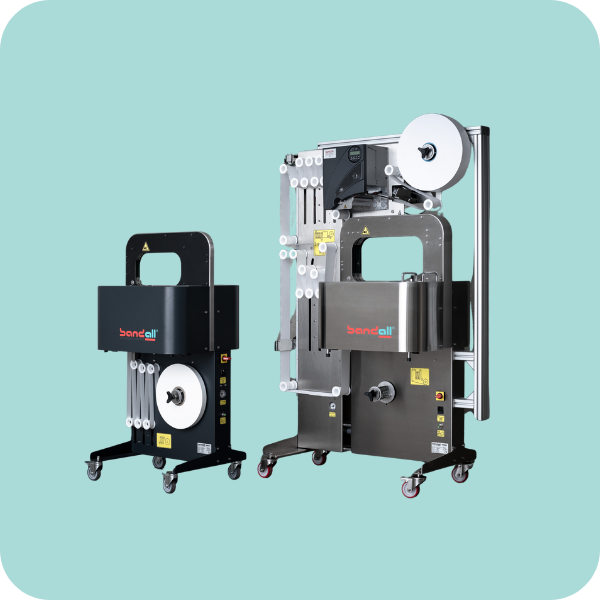
4. Consider integration with your existing production line
If you operate an automated packaging line, seamless integration at the end of the line is essential.
Important integration factors include:
- Conveyor height and speed
- Available floor space
- Communication between machines
- Upstream and downstream synchronization
- Safety and compliance standards
A properly integrated banding machine prevents disruptions and ensures stable throughput. When banding needs to be implemented in-line, modular banding machines often provide the most efficient and flexible solution.
5. Plan for future scalability
Choosing a banding machine is a long-term investment. Your future needs may exceed your current production capacity.
Think ahead about:
- Expected production growth
- New product formats
- Increasing sustainability regulations
- Retail requirements for branding and packaging reduction
Selecting a scalable solution now may prevent costly upgrades or replacements later.
6. When to consider a complete tailor-made banding solution
Standard machines are suitable for many applications, but some production environments require customization.
Custom solutions may be necessary when:
- Extremely high speeds are required
- When a single banding head is not sufficient
- Or when floor space needs to be utilized efficiently
In such cases, a custom-built banding machine ensures optimal performance and full compatibility with your production process.
Common mistakes when choosing a banding machine
Avoid these frequent errors:
- Selecting based only on price
- Underestimating future production growth
- Ignoring integration complexity
- Overlooking material compatibility
- Failing to consider operator usability
A structured evaluation prevents costly adjustments later.
How to make the final decision
Choosing the right banding machine often comes down to the factors mentioned above. When these elements are clearly defined, selecting the right solution becomes a little easier.
If you would like tailored advice, our specialists can analyze your production environment and recommend the most efficient banding machine in our collection for your application.
Explore our banding machines or contact our team for expert guidance.

Applications of banding

Benefits of banding

Banding vs. other solutions

10 Reasons to switch to banding

Zwartz - From shrink wrap to paper bands

Novatrade - Improved quality and efficiency

Packaging food products
